

Easter Island
More-head-than-body-and-not-particularly-friendly-looking

Some flowers are better suited for competitive arranging than others. I love hydrangea, delphinium, and lilac, but I don’t trust them as far as I can throw them (which, upon occasion, I have.) No matter how well conditioned they are, sometimes you get one that kicks the bucket for no reason.
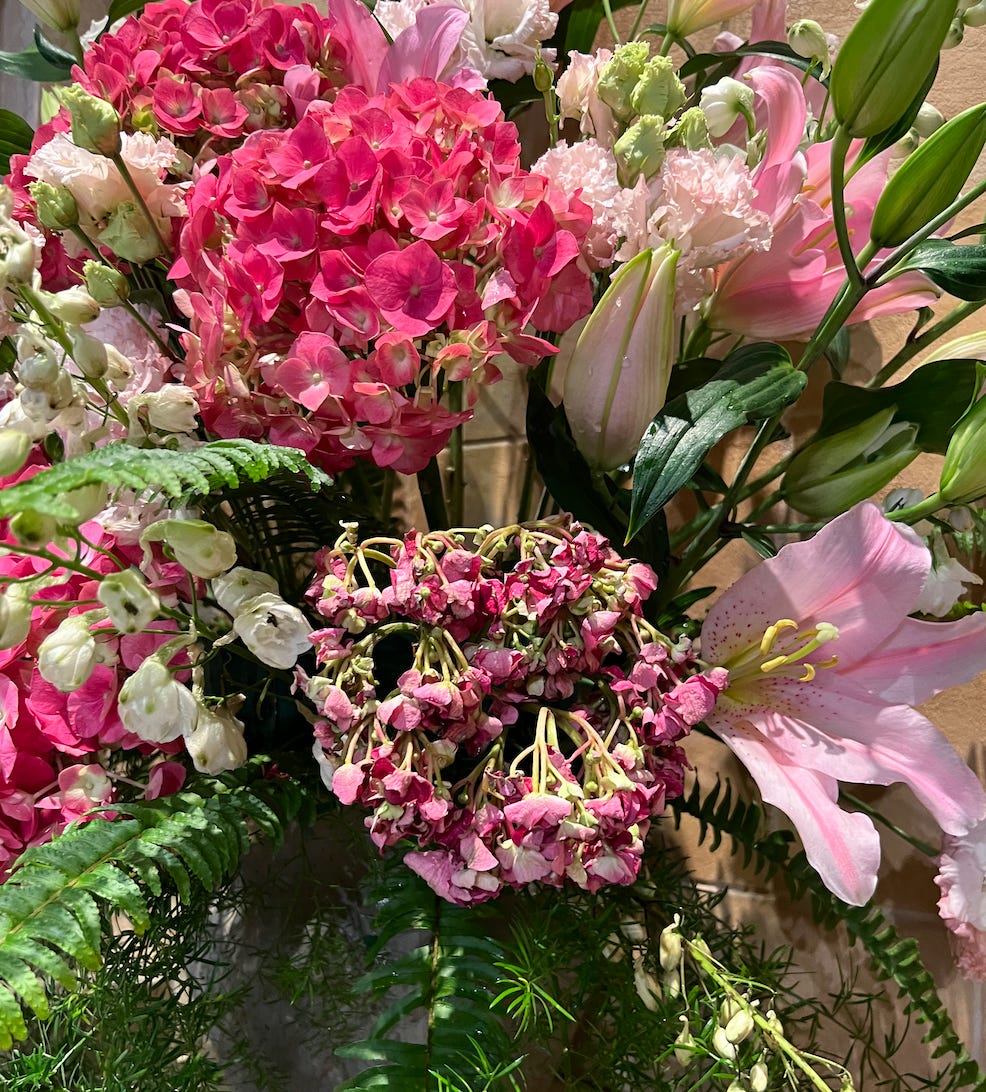
A competitive arrangement is expected to be in “prime show condition” at all times—in other words, fresh. I’ve never read a schedule that didn’t threaten, in some way or another, to take away your ribbon if any part of your design droops—or, heaven forbid, dies—before the end of a show. These threats, however, tend to be somewhat idle as I’ve seen plenty of droopy arrangements but never known one to have its ribbon yanked.
This being the case, I’m always on the lookout for plant material that’s able to spend a day or two in drought conditions and still appear hale and hearty. Protea and her Leucadendron cousins—along with Brunia and Anthuriums—are all so inclined. There is nothing like a flower that, after lying around on the floor all day covered in verdurous trash, can rise to the occasion come showtime.
Lost Worlds…Paradise Regained was the name of the garden club’s flower show in 2009. The class titles included a selection of weird places—real and imagined—everything from the “Lost City of Atlantis” to “Easter Island.” The schedule didn’t particularly inspire me, but since Brantley Knowles was the Flower Show Chairman and a friend (and knowing what a pain it is to get people to sign up), I promised to enter.
“Why don’t you do ‘Atlantis’,” she suggested. “I can’t get anyone to sign up for that one.”
It wasn’t hard to see why: she had staged the class on the museum’s largest pedestals, which are a yard wide, two feet deep, and forty-two inches tall. Those pedestals are usually reserved for grandiose mass arrangements. To be in proportion, any underwater design displayed on a pedestal that big would need a tank the size of a suitcase. The thought of filling and un-filling a vessel that big—not to mention keeping the water gin clear for the duration of the show—gave me indigestion. I decided to do “Easter Island.”
As lost worlds go, Easter Island certainly qualifies. I love remote, but this place is in the middle of the Pacific Ocean, 2300 miles off the southeast coast of Chile. The Dutch explorer Jacob Roggeveen stumbled upon it on Easter Sunday in 1722. The original inhabitants called the island Rapa Nui.
The Moai, those monolithic, more-head-than-body-and-not-particularly-friendly-looking stone statues are huge, ranging from six to thirty feet in height and weighing more than two tons. There are nearly nine hundred of them on the island, and no two are alike.
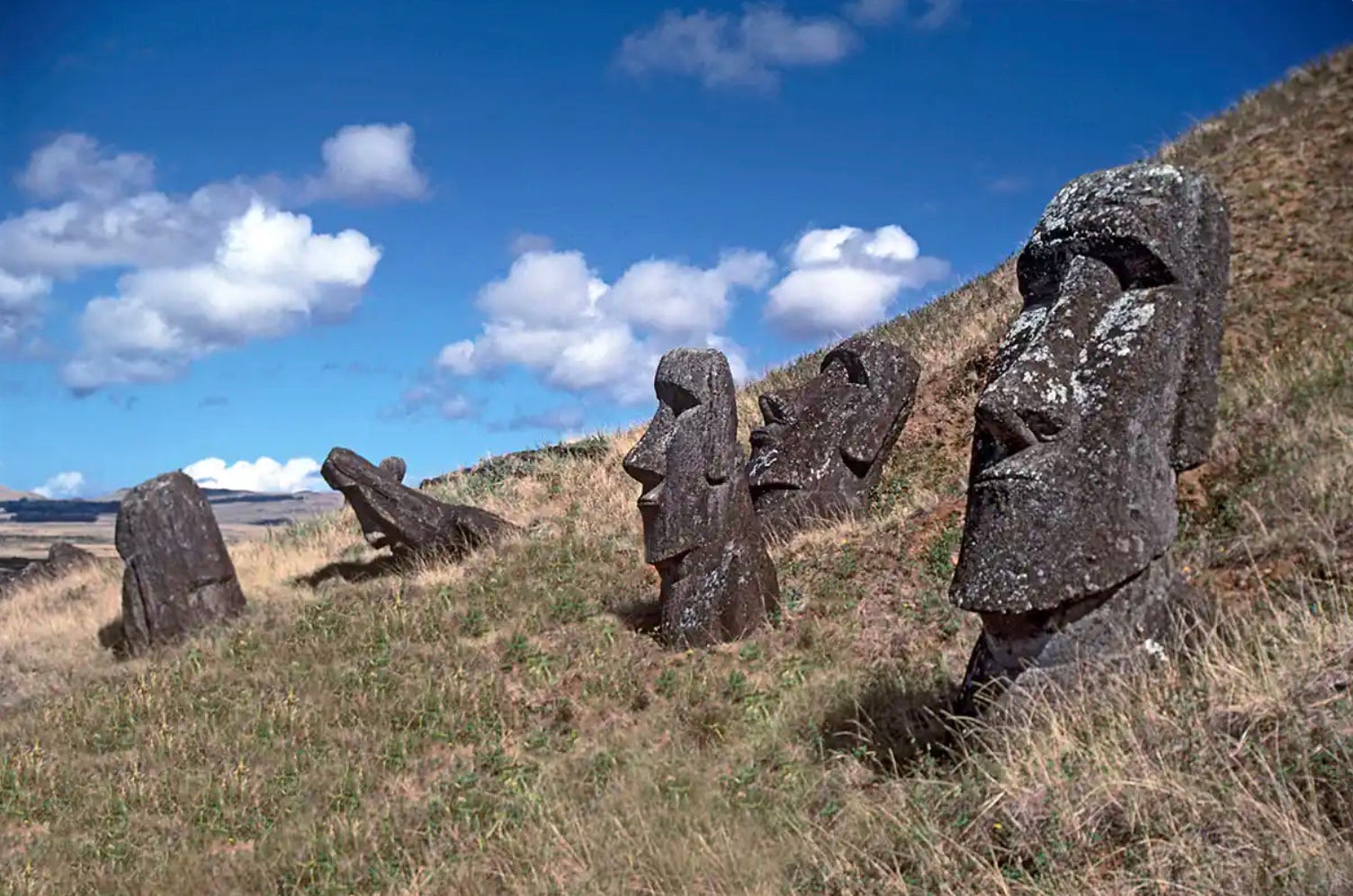
There’s a lot of speculation about who carved these figures, and even more about how they moved them. The island was completely denuded at some point, leading some to hypothesize that the natives chopped down all the trees and rolled the Moai into place atop logs. Some say extraterrestrials visited Easter Island and moved them. Somehow, I don’t see aliens being that accommodating.
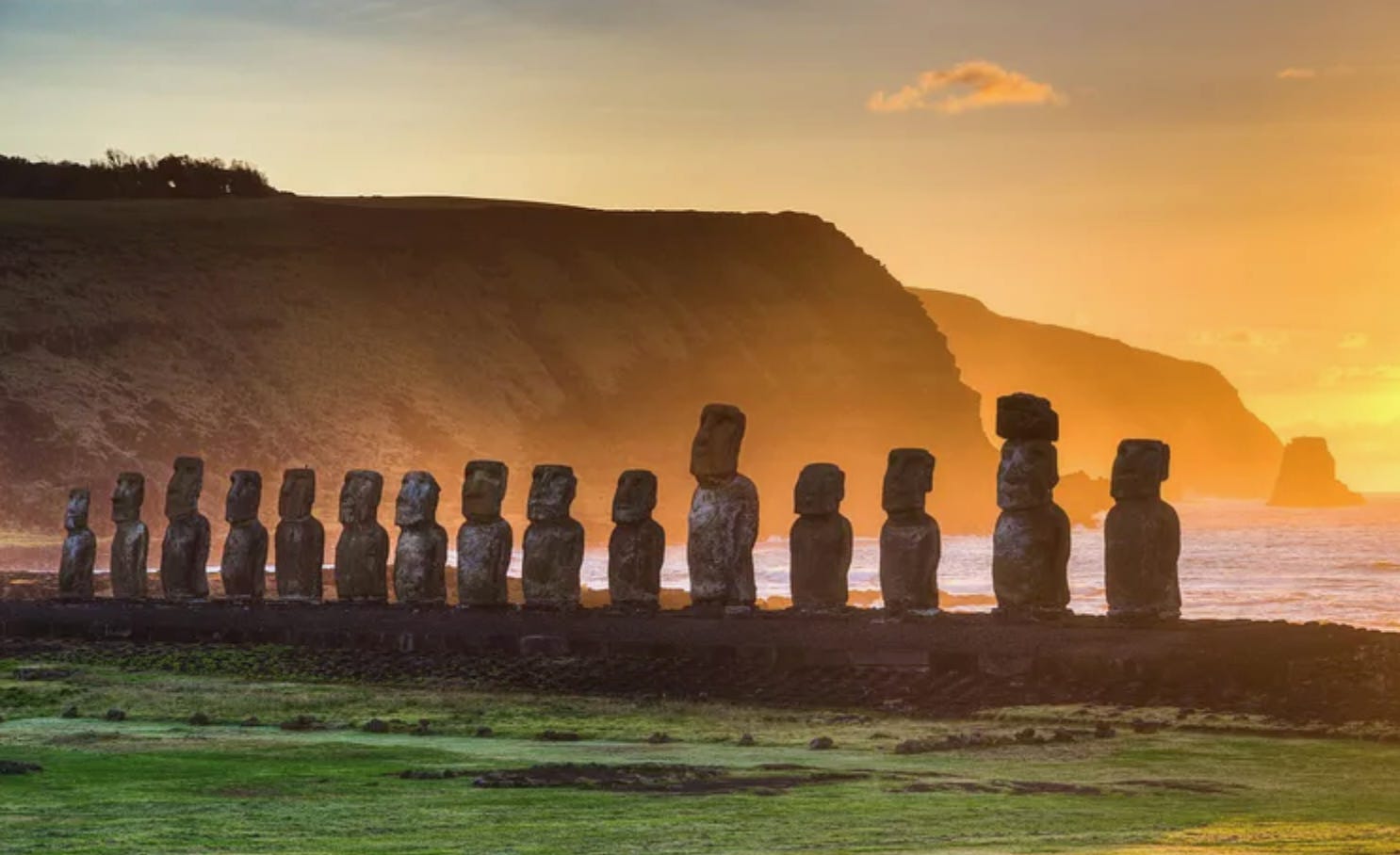
But when deciding how to interpret Easter Island, I chose to ignore the Moai—and the aliens—and concentrate on the island itself, which is about the size of Hilton Head, that overdeveloped golf destination in South Carolina shaped like a shoe.
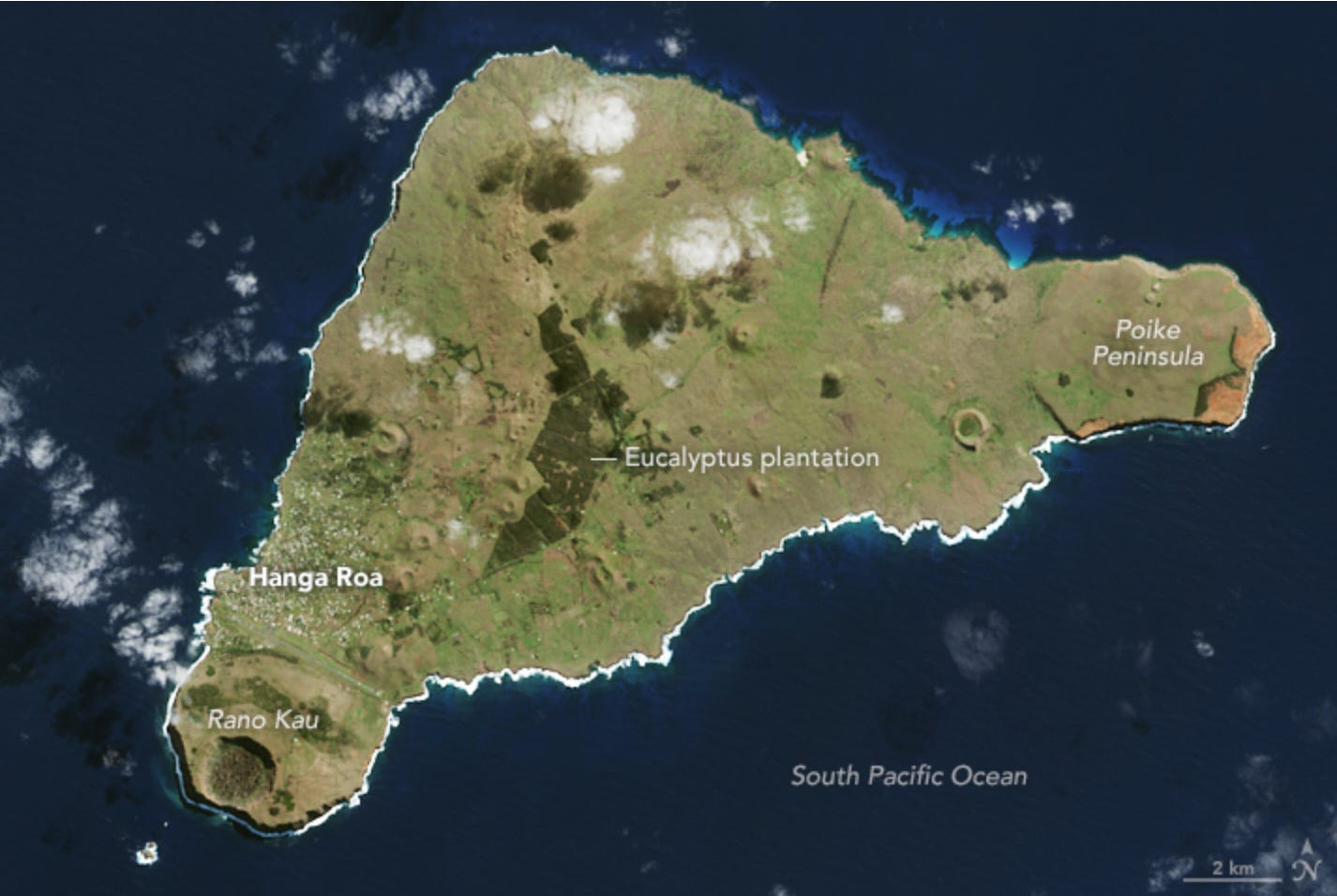
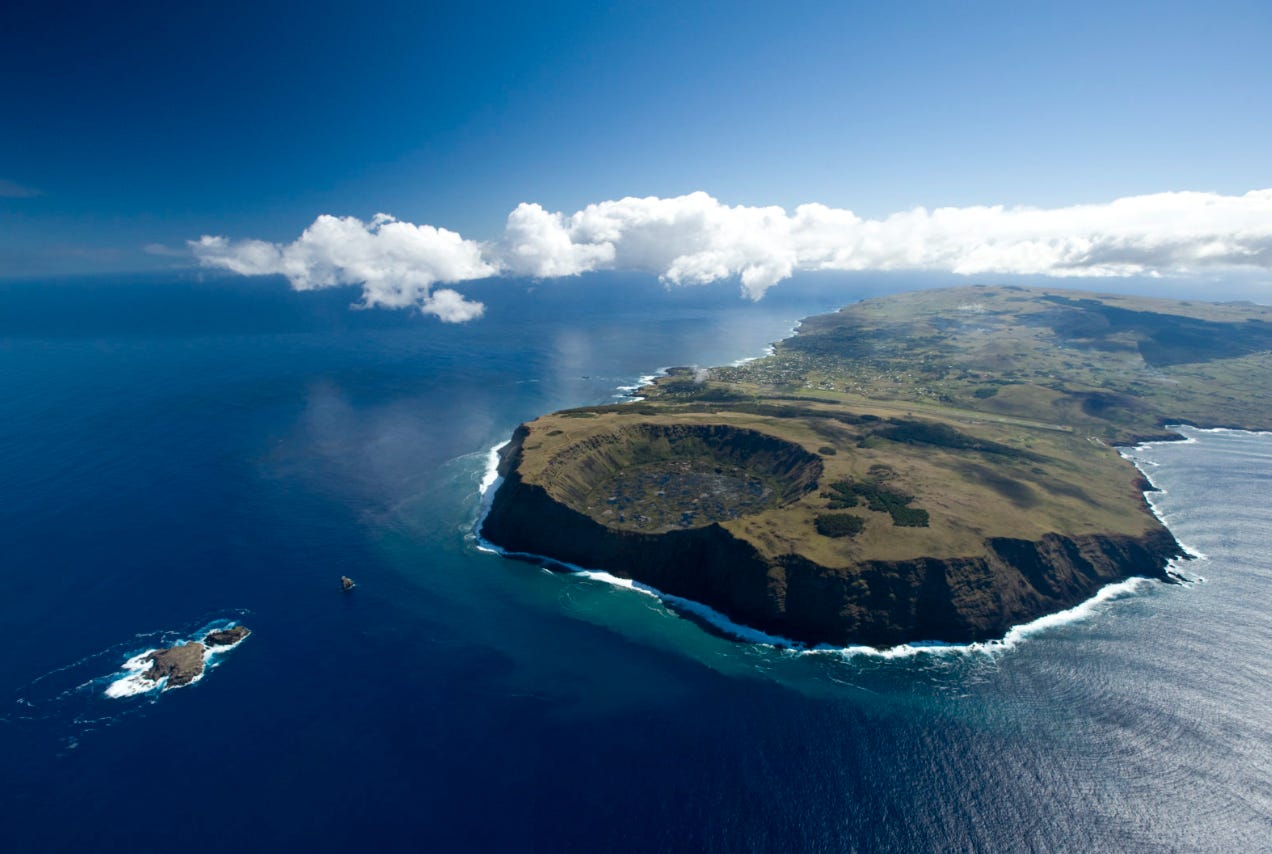
Easter Island was formed by three volcanoes and is the color of lava rock, with a coastline that is steep, rocky, and uninviting. Should you happen to be cruising the area, it’s not the sort of island paradise like, say, Bali Hai, where one might hear, “Come to me! Come to me!” More like, “Stay away! Stay away!”
I wanted my arrangement to be an amalgamation of lonely, isolated, and foreboding, which would necessitate finding plant material the color of lava rock. It was about this time that I discovered Brunia (Brunia laevis).
“Mama, what does laevis mean in Latin?” I could have looked it up, but figured as long as I had her on the phone, I’d ask.
“Well, it all depends on how it’s used.”
“It’s a plant.”
“In that case, I don’t think it’s ‘left-handed’,” she said.
“Probably not.”
“Smooth, it probably means ‘smooth’.”
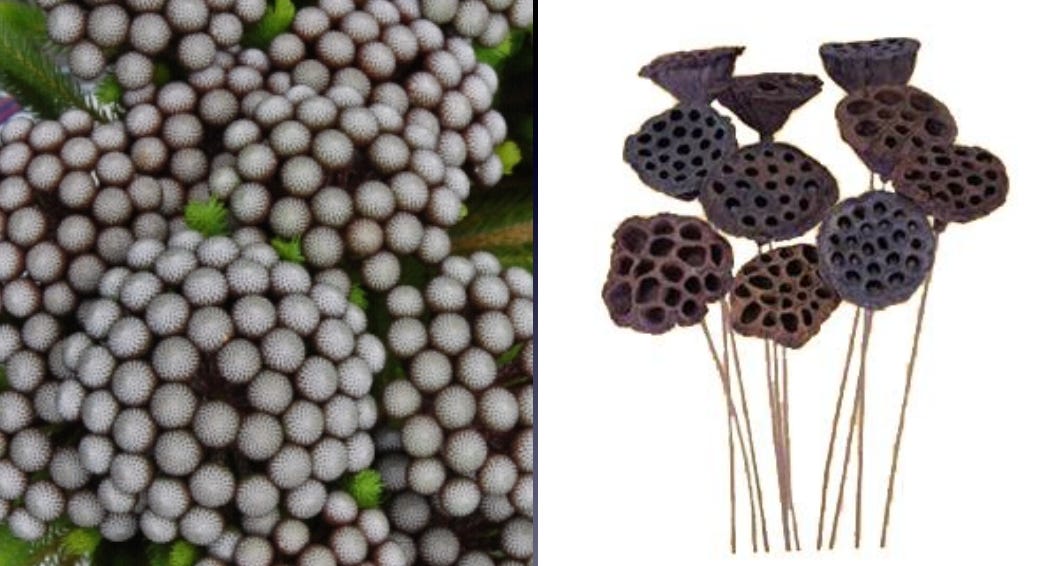
Brunia is an evergreen with small needle-like leaves reminiscent of a Douglas fir, America’s preferred species of Christmas tree. The inflorescence, which includes all parts of a flower head—stems, stalks, bracts, and flowers—is a cluster of silver-gray balls about the size of chickpeas. They reminded me of dusty lava bubbles, not that I’d ever seen any.
“Is Brunia available in April?” I asked the clerk at the local floral supply.
“Silver-gray or green?”
“Silver-gray,” I said. “I didn’t know it came in green.”
“And white,” he said. “Yeah, I can get you some in April.”
I ordered twenty bunches, each containing about ten stems. I had no idea how I would arrange them, but the answer came about a week later while browsing the vendors’ stalls at the Philadelphia Flower Show. I was with the aforementioned Lost Worlds—Paradise Regained Flower Show Chairman, who was still on my case about entering the underwater arrangement class.
“I’m not entering the ‘Atlantis’ class,” I said. “I’m doing ‘Easter Island,’ and nothing else.”
But with me, you never know. I’m famous for caving under pressure and agreeing to do arrangements I had no intention of doing. So, to be on the safe side, I purchased a small cracked column from one of the vendors, thinking it looked like a relic one might stumble upon should one ever find the Lost City of Atlantis. Right.
Five minutes later, after shelling out fifty dollars for the stupid cracked column, I found my Easter Island container. Handcrafted out of grayish-green clay, it was about fourteen inches tall and equally as wide, randomly pleated, if you can imagine, with ins and outs that immediately brought to mind the island’s craggy coastline. I had to have it. Three hundred and ninety-five dollars later, it was mine.
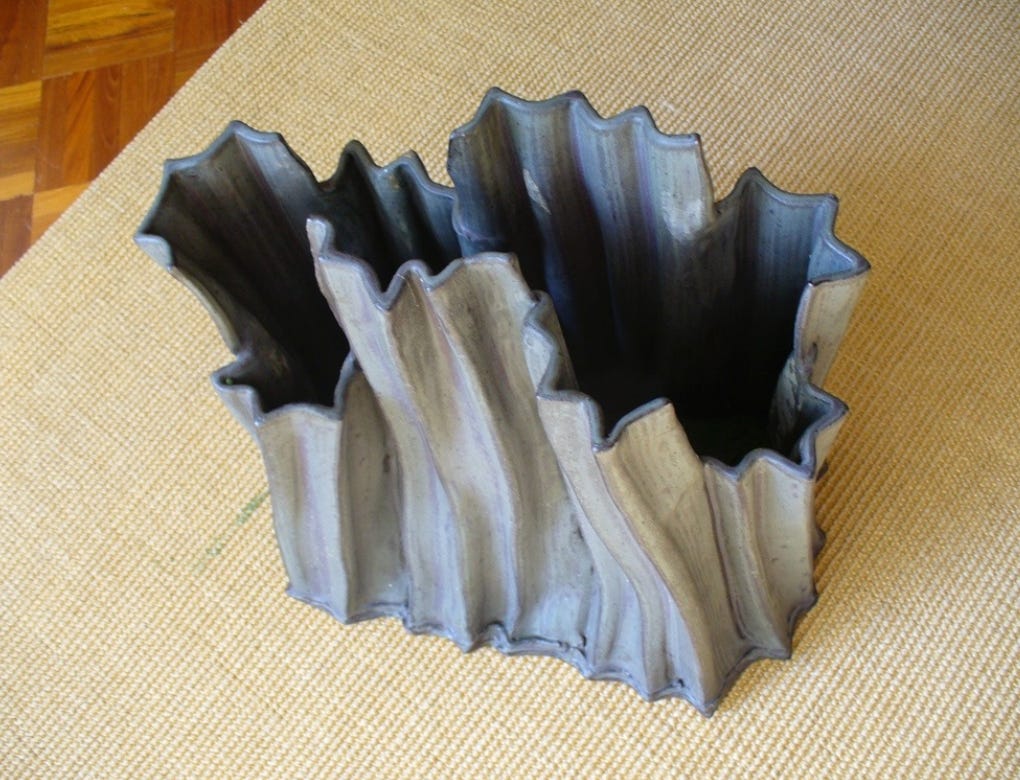
“What’s this?” asked the TSA agent at the Philadelphia airport as I struggled through security, new container in tow. It, of course, had to be unwrapped and inspected.
“It’s a vase,” I said. She instructed me to follow as she carried the costly container over to a table and set it down. With one of those cloths on the end of a stick designed to detect bomb-making residue, she gave it a wipe.
“Well, there’s nothing pretty about it,” she said, handing it back to me, along with a wad of bubble wrap. “You can go.”
It’s ‘may,’ I thought, but fearing a full cavity search, I kept my mouth shut. My mother, on the other hand, would’ve corrected her in a heartbeat, cavity search or not.
The Brunia, which I pavéd across the top and down one side of my new Easter Island container, appeared to ooze like lava. To break the textural monotony, I added dried lotus pods (Nelumbo spp.) here and there—their holes were almost the same size as the Brunia buds and repeated the overall bubble pattern, a serendipitous detail.
I placed dried, finger-shaped Bismarkia (Bismarckia nobilis) palm panicles in the back of the arrangement, with the tips of one or two poking through the Brunia, creating points of emergence.
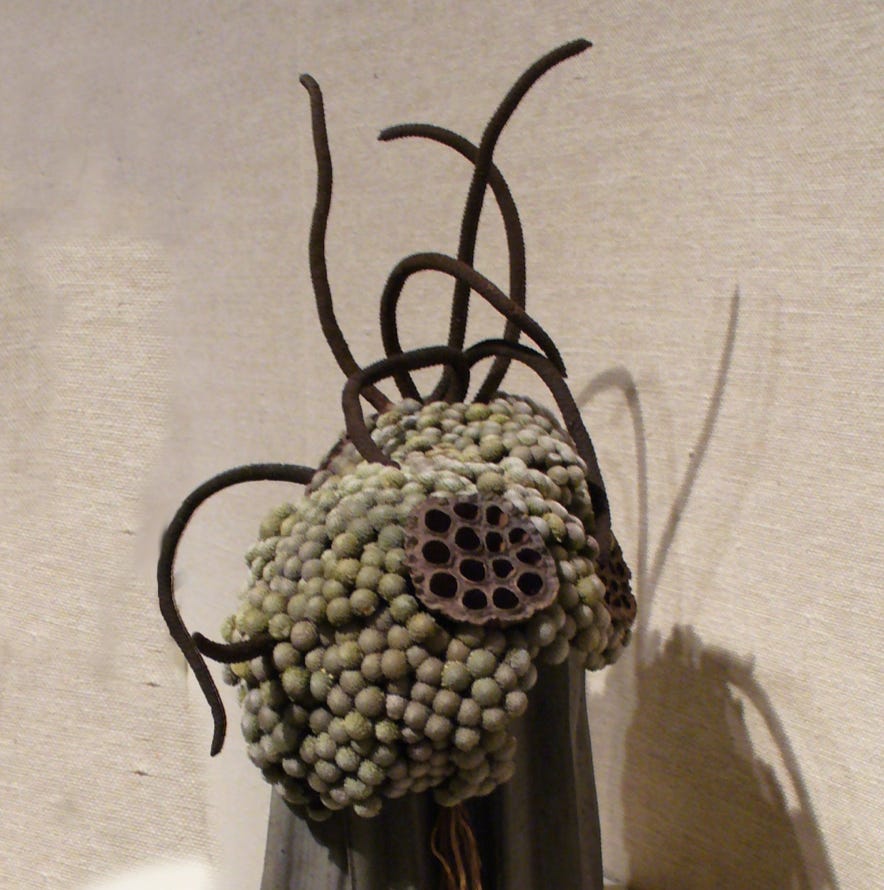
According to one club member, it looked like a wooly mammoth. I didn’t know whether to be insulted or flattered, but it did seem to have a life of its own. Except for “Alien Invasion,” it was, quite possibly, the most unorthodox flower arrangement I’d ever done.
“Are you ready to have it passed?” someone asked.
“No, it’s still not quite right.”
It looked as though it might, at any minute, levitate off the pedestal. It needed an anchor, something to weight it down visually. But what?
With an hour to kill, I headed up the bike path behind the Four Arts Gallery, where I found a big banyan tree. I had strolled past it hundreds of times with my girls over the years, never failing to notice the wispy vines hanging from its branches. Once these vines reach the ground, they take root, forming vertical limbs, which secure the tree against high winds. I whacked off a few—which is probably illegal—and headed back to the gallery, where I gave them a good wash; bugs are an automatic disqualifier. I tucked a small skein into the container, allowing it to spill down the right side and onto the pedestal. This simple addition settled the design.
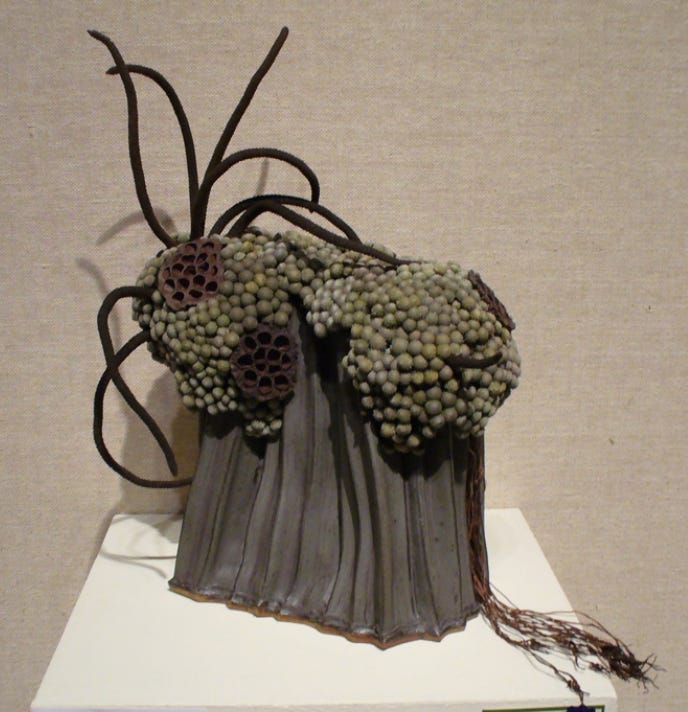
It won Best in Show and the Puckett Creativity Award. Having done it alone, I was pretty proud of myself, until a woman standing next to me at the Preview Party loudly exclaimed, “How the hell did that thing win? That’s the ugliest arrangement I’ve ever seen.”
“Blind luck,” I said, and headed toward the bar.
“Ooze” is one of my favorite words. And that arrangement just oozes ugly. “Probably illegal” my favorite phrase here. But the comment that woman makes at the end seals it. I laughed out loud. Thanks. Mary, your VISION and attention to detail boggles the mind. Can’t wait to read the next one!
I just love your fabulous “flora” stories, Mary! (And they’re TRUE!). Look forward to your next ! Xo, Brooke